Runner Records
Daisy Jones & the SixRunner Records is the record company and publisher at the center of the band’s rise, linking discovery, contracts, production, promotion, and touring. Its support makes The Six and Daisy Jones commercially visible, but its deadlines and investment in marketable results also place the company inside the creative pressures that alter the band’s music and internal balance.
Identity and Early Signings
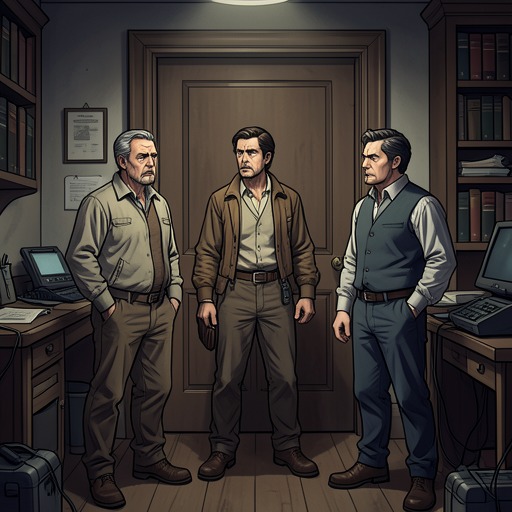
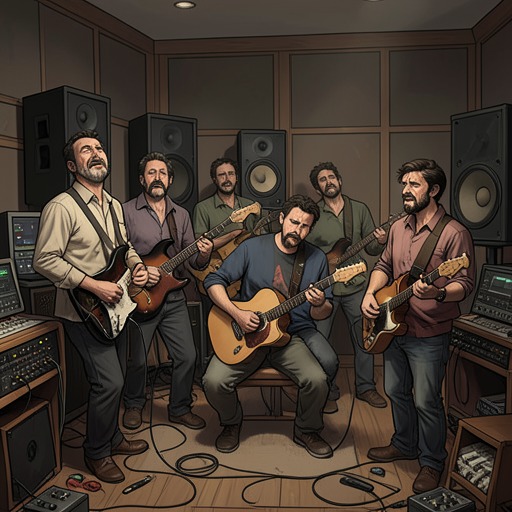
Runner Records first enters the band’s story through producer Teddy Price, who hears The Six at the Troubadour after an assistant has alerted him to their performance at P.J.’s. Price tells Billy Dunne that he recognizes his talent for writing about Daisy Jones, connecting the company’s attention to the songwriting already emerging from the band rather than to an established hit. After visiting a rehearsal space in the San Fernando Valley to hear the seven songs the group has prepared, Price brings them to the company’s offices. There they meet chief executive Rich Palentino and receive a recording and publishing deal, with Price personally assigned to produce their album.
The signing gives the six band members a tangible threshold into the Los Angeles music business. Graham Dunne recalls leaving the offices in late afternoon and walking with the others along Sunset Boulevard, the record contract in his pocket and the sun in their eyes. His memory presents the deal not simply as paperwork, but as a moment when the band experiences the city as having welcomed them. For Runner, the agreement secures both a recording project and publishing rights, while Price’s role makes the company’s commitment visible in the studio as well as in the contract.
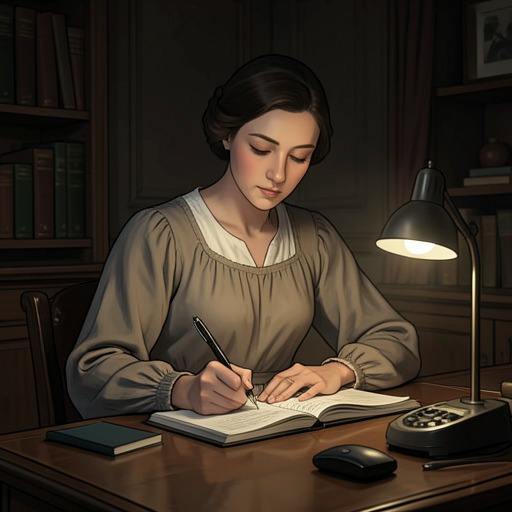
Runner also signs Daisy Jones after she rejects the approach to a demo session that her manager, Hank Allen, wanted her to record. At Larrabee Sound, Jones refuses to sing the requested song in the smoother style Allen asks for and leaves the session. She is signed soon afterward. Although she says she cared chiefly about writing and performing her own songs, she signs without reading the contract, preferring to write and get high rather than attend to its financial obligations. The contrast is central to Runner’s place in her early career: the company offers a route for her work into the industry, while the agreement is one of the business arrangements she chooses not to examine closely.
From Individual Releases to a Shared Tour
By 1974, Jones has repeatedly failed to appear for recording sessions at the Record Plant in West Hollywood and is in breach of her Runner contract. Her first album, First, appears at the beginning of 1975. Runner markets her as a Dusty Springfield imitator; the cover places her looking into a mirror against a pale yellow background. The album is not described as groundbreaking, though later listeners can hear grit beneath its surface. Its first single, a version of “One Fine Day,” offers a more complex treatment than most versions, and her second single, “My Way Down,” is warmly received. These details show the distance between Runner’s promotional framing of Jones and the musical edge that becomes more apparent in her recordings.
After Jones performs with The Six at the Whisky, Runner announces that she will open for the band on the Numbers Tour. Billy appeals to Price, Rod Reyes, and Palentino to have her removed from the bill. Price counters with ticket-sale figures: sales are climbing and additional dates are being added. Billy ultimately accepts the arrangement. The decision makes commercial demand an explicit force in the band’s lineup; Jones’s opening slot is not merely an artistic choice but a response to the audience the company expects her to draw. By the time the tour begins, “Honeycomb” has entered the Top 20, and the band and Jones are being promoted together.
The success continues through the end of 1976. “Honeycomb” reaches number three on the Billboard Hot 100, and the combined act performs it on Don Kirshner’s Rock Concert and The Tonight Show Starring Johnny Carson. The North American dates conclude before a short European leg, while Camila Dunne, six months pregnant, returns to Los Angeles with Julia. The band’s growing reach therefore unfolds alongside the practical limits of keeping family life on the road. Runner’s commercial framework expands the group’s opportunities, but touring success also increases the distance between the band’s work and the lives waiting at home.
Deadlines, Production, and Promotion
As work on the album that becomes Aurora advances, Runner sets a release expectation: the album is wanted toward the beginning of 1978, and by the time that instruction is relayed to the band it is already August. The schedule sends the group back to work despite creative disagreements and arguments over authority. At the same time, Rod Reyes presses Price to secure substantial company backing: a large first pressing, a clear hit single, rock and pop radio play, and a major tour. He expects a forceful launch, and says that the prospect of Jones and Billy promoting the album together would sell tickets and records. The company’s investment and the band’s anticipated appeal become mutually reinforcing expectations.
That expectation shapes the album’s production as well as its release plan. When the band gathers at Runner’s offices to hear the final mix, its members discover that Billy and Price have changed more than they had understood during the recording process. Eddie Loving objects that Price has changed his guitar part on “Chasing the Night,” and says the tuning of “Please” was altered and the part rerecorded in Nashville tuning. Karen Karen finds that her keys have been removed from two songs. The band’s objections are sharpened by Runner’s enthusiasm: executives are discussing stadium bookings and a pressing of more than a hundred masters, while “Turn It Off” is being proposed as a possible number-one single. The prospect of commercial success helps explain why objections to the changes go largely unvoiced, even as the altered arrangements expose how much control the production process has concentrated in Billy and Price.
Runner’s release campaign is coordinated across radio, television, and the music press. “Turn It Off” becomes the first single; the band is booked on Midnight Special and sent to radio stations around the country for appearances before the album’s release. In the same week that Aurora reaches stores, the band appears on the cover of Rolling Stone beneath a headline asking whether Billy and Jones are rock ’n’ roll’s biggest foes. The campaign places a musical product and a public story of rivalry side by side. What the company promotes is not only the album but also the tension between its most recognizable performers.
Commercial Peak and Touring Infrastructure
The campaign succeeds on an extraordinary scale. “Turn It Off” spends four weeks at number one, and Aurora sells more than 200,000 units each week. In the summer of 1978, Daisy Jones & The Six is described as the act to see; the tour sells out stadiums, and additional shows are booked in major cities. The label’s earlier attention to sales, radio exposure, and tour planning has become a cycle of escalating demand: high sales support larger venues and more dates, while the tour makes the group’s public profile still more visible.
The practical arrangements reflect both the scale of the operation and the antagonism between its stars. The group travels in two buses, one associated with Billy’s denim shirt and the other with Jones’s tank top, in part because the two do not want to have to look at one another. Tour accountant Opal Cunningham says the band spends more each day and disregards her attempts to control costs. Even tour requests, from baby grand pianos in hotel suites to Sharpies for autographs, must be matched between Billy and Jones so neither is given something the other lacks. The rider grows to twice the length it needs to be. Reyes routinely tells Cunningham to clear the expenses because Runner will pay; he recognizes the waste but reasons that, with the country’s biggest album, granting the requests is in the company’s interest.
Commercial prominence also changes the scale of the audience around the performers. In San Francisco, fans begin screaming as Billy exits one bus, and the noise grows louder when Jones appears; Reyes and Niccolo Argento help hold the crowd back as the two enter the hotel. Runner’s investment is thus associated with more than sales figures: the publicity and touring machine helps place the band before crowds whose attention makes ordinary movement difficult. Yet the tour’s paired buses and duplicated requests show that greater success does not resolve the musicians’ conflicts; it gives those conflicts an expensive logistical form.
Continuing Relationship and Significance
Runner’s relationship with Billy continues after his time in the band. In 1981, he signs a publishing deal with the company and writes songs for pop singers. He describes the resulting life as quiet and stable, contrasting it with his years in the group. His account does not present the publishing arrangement as a return to the same kind of public career: instead, it marks a later professional path built around songwriting after he has left the band.
Across these episodes, Runner Records functions as both an enabler and a commercial authority. It gives The Six a recording and publishing contract, brings Price into their work, signs Jones, joins the two acts on a tour, and supplies the resources behind Aurora’s extensive promotion and stadium-scale success. At the same time, its deadlines, sales calculations, production decisions, and willingness to absorb extravagant tour costs affect what the musicians record and how they work together. The company’s role is therefore not reducible to either patronage or interference: its investment opens doors, while the machinery built to convert that investment into hits and ticket sales becomes part of the pressures the band cannot leave outside the studio.